
Gen AI for Legacy App Modernization: Practical Use Cases and Business Benefits
Discover how Gen AI for legacy app modernization helps businesses upgrade outdated systems, reduce costs, improve efficiency, accelerate development, and enhance user experiences through intelligent automation and innovation.
GUEST POSTS
6/3/20266 min read
1. Code Analysis
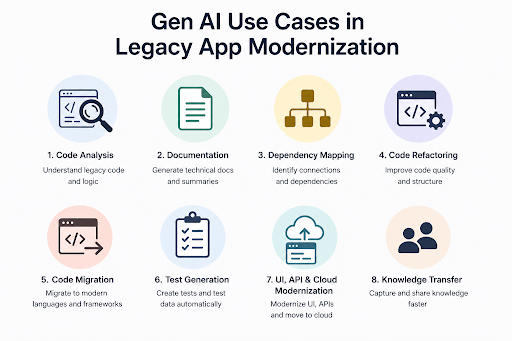
Engineers use Gen AI to get up to speed on legacy code without reading every file. It explains what modules and functions do, maps out dependencies, and surfaces business logic that would otherwise take days to find. This matters most when the original developers are gone and the documentation covers maybe half of what the system actually does.
2. Documentation Generation
Outdated or absent documentation is one of the most common problems in legacy systems. Gen AI can produce technical docs, API descriptions, architecture notes, and summaries of business rules. The output needs review, but it gives the team something to work from rather than starting with a blank page.
3. Dependency Mapping
Legacy applications are full of hidden connections modules, databases, APIs, third-party services all tangled together in ways nobody fully documented. Gen AI can surface those connections before the team starts making changes. Finding a dependency after you've broken it is far more expensive than finding it beforehand.
4. Code Refactoring
Gen AI can flag duplicate logic, suggest cleaner patterns, replace things that are outdated, and improve readability. Engineers still need to review and test everything AI suggestions are a starting point, not a finished product. But refactoring goes faster when you're reviewing and adjusting rather than writing from scratch.
5. Migration of Code
The process of moving from older programming languages or frameworks can be a cumbersome task. AI technologies can convert commonly used code patterns to current models of functionality; this capability is particularly useful for migrating older versions of Java, modernizing older versions of .NET Framework, migrating from AngularJS, and upgrading/modernizing from PHP. While AI does not have a 100% success rate in transforming these older code patterns into their latest equivalents, it takes care of a large portion of the mechanical portion, thus reducing the project timeline significantly.
6. Test Generation
Tests must be established prior to beginning to work on legacy code, otherwise, you will not know what changes you have created until they produce undesirable results in production. Gen AI can generate unit tests, integration tests, and regression scenarios along with producing test data that allows your team a safety net to work against before modifications are made.
7. UI, API, and Cloud Modernization
Gen AI also supports UI updates, API redesign, and cloud migration planning. It can analyze existing workflows, suggest better integrations, and map out steps for moving legacy systems to modern infrastructure. The output still needs a technical review these aren't areas where you want to run AI suggestions unexamined.
Advantages of Applying Gen AI for Legacy Modernization
Speed is the clearest benefit. Discovery, documentation, testing, and refactoring all take less time when AI is doing the volume work and engineers are reviewing and directing rather than executing every step manually.
Other benefits tend to follow from that:
Faster initial assessment of a system's actual state
Less manual effort during discovery and documentation
Better visibility into what the legacy code is actually doing
Stronger test coverage before changes start
Lower risk going into the modernization itself
Faster delivery once work is underway
Lower maintenance costs once the work is done
Easier onboarding for developers joining the project mid-stream
There's also a preservation benefit that's easy to underestimate. Rebuilding a system from scratch means the business logic accumulated over years can quietly disappear. Gen AI can extract and document that logic before any changes happen, so it doesn't get lost in the process of replacing it.
Ways to Utilize Gen AI for Modernizing
Use Gen AI to support engineering team members rather than replacing them as they go through their engineering modernization and creation processes.
The first step in creating a successful engineering modernization effort is to assess the current state of the engineering environment including architecture, codebase, cloud infrastructure, integrations, data flows, etc. Engineering can use Gen AI in this phase to generate summaries of code, map out dependencies between various components of the application ecosystem, and create documentation that would require weeks to do without AI.
Once the current-state assessment is complete, the engineering team will determine which approach to take for the modernization project:
(1) Some systems will only require selective improvements;
(2) Some systems will require more extensive re-architecting or a transition to the cloud; and
(3) Work to modernize a system should be performed in phases versus all at once so as not to disrupt business operations while simultaneously keeping both engineering and business risks to a minimum.
All AI-generated engineering outputs must be reviewed by engineering and domain experts prior to production. Code, documentation, tests, migration suggestions, etc., cannot be released to production without engineers and/or domain experts reviewing them.
Final Thoughts
Gen AI makes legacy app modernization faster and less painful. It helps teams get their arms around old systems, document buried business logic, build test coverage, support refactoring and migration work, and cut the amount of manual effort the project requires.
It's not a shortcut past the hard parts.
Successful modernization still depends on engineering expertise, a clear sense of what the business needs, careful planning, and real quality assurance. AI doesn't change that. What it does is make each of those things faster and more grounded which is enough to meaningfully change how long a project takes and how confidently a team can move through it.
Most businesses are running on old software. Not old in a charming way old in the sense that the team maintaining it has shrunk, the original developers are gone, and the documentation is either missing or confidently wrong. Every change takes longer than it should, and every new feature carries the quiet risk of breaking something nobody fully understands anymore.
Generative AI cannot magically solve legacy system problems on its own. Instead, it reduces the number of hours engineering teams spend doing dull and laborious work such as reading through lines of code without comments, figuring out the dependencies between various pieces of code, and trying to determine which parts of the codebase implement critical functionality for the business. Generative AI helps engineering teams to spend their time on activities where their expertise is essential.
What Is Legacy App Modernization?
When we talk about modernizing systems, including legacy system modernization services, we're actually trying to bring older systems into an environment that still allows them to function and not break down when someone tries to use, change, or add something to the system. It's also about things like changing your codebase, moving your system into the cloud, replacing old dependencies, redesigning your user interface, increasing security, and integrating your system(s) with other business-critical systems.
Many of the warning signs associated with systems in need of some help happen to cluster together, such as: Continued year-over-year increase in maintenance costs; the length of time it takes for new features to be delivered (and in some cases years); perceived fragility of integration hubs; distrust in documentation; and failed user experience to the extent that users choose to work outside of the application rather than with it.
An outcome of a modernization effort is not necessarily a complete rebuild from the ground up. "It often makes much more sense to modernize incrementally," meaning, keep the business logic that works as you replace the technology behind it.
How Gen AI Helps With Legacy Modernization
The hardest part of any modernization project is the first part: understanding what the system actually does. Legacy applications from ten or fifteen years ago often have business logic buried three layers deep in code that nobody thought to document, written by people who left the company long ago.
Gen AI can cut through a large codebase faster than manual review. Feed it a module and it can explain what the code does, summarize dependencies, flag what's calling what, and generate documentation from scratch. It can suggest where refactoring would help and build test cases against existing behavior.
By building a working representation of an existing system (legacy system), engineers are provided with a practical benefit. Instead of spending days reading through hundreds of files, engineers can perform all the engineering tasks necessary to transform a functional system into a legacy system. This allows engineers to focus on the work that cannot be delegated to others: design decisions, validating AI results and determining the correct decision based on the business context needed for an action.
Key Use Cases of Gen AI in Legacy App Modernization
Gen AI shows up at different points in a modernization project. Here's where it tends to earn its keep.


Community
Company
Resources
© 2024. All rights reserved.